
 38042.jpg
27 Seiten, PDF-E-Book
Erschienen: Oktober 2025
Bestell-Nr.: 38042
https://doi.org/10.30820/2752-2245-2025-2-27
abonnieren
Peter Christian Endler
Freud unter dem Bodhi-Baum (PDF)
Aspekte von (Gruppen-)Psychoanalyse und Frühbuddhismus
Sofortdownload
Dies ist ein E-Book. Unsere E-Books sind mit einem personalisierten Wasserzeichen versehen,
jedoch frei von weiteren technischen Schutzmaßnahmen (»DRM«).
Erfahren Sie hier mehr zu den Datei-Formaten.
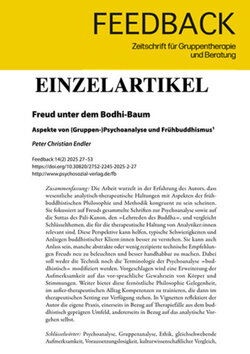
Die Arbeit wurzelt in der Erfahrung des Autors, dass wesentliche analytisch-therapeutische Haltungen mit Aspekten der frühbuddhistischen Philosophie und Methodik kongruent zu sein scheinen. Sie fokussiert auf Freuds gesammelte Schriften zur Psychoanalyse sowie auf die Suttas des Pali-Kanon, den »Lehrreden des Buddha«, und vergleicht Schlüsselthemen, die für die therapeutische Haltung von Analytiker:innen relevant sind. Diese Perspektive kann helfen, typische Schwierigkeiten und Anliegen buddhistischer Klient:innen besser zu verstehen. Sie kann auch Anlass sein, manche abstrakte oder wenig rezipierte technische Empfehlungen Freuds neu zu beleuchten und besser handhabbar zu machen. Dabei soll weder die Technik noch die Terminologie der Psychoanalyse »buddhistisch« modifiziert werden. Vorgeschlagen wird eine Erweiterung der Aufmerksamkeit auf das vor-sprachliche Gewahrsein von Körper und Stimmungen. Weiter bietet diese fernöstliche Philosophie Gelegenheit, im außer-therapeutischen Alltag Kompetenzen zu trainieren, die dann im therapeutischen Setting zur Verfügung stehen. In Vignetten reflektiert der Autor die eigene Praxis, einerseits in Bezug auf Therapiefälle aus dem buddhistisch geprägten Umfeld, andererseits in Bezug auf das analytische Vorgehen selbst.
Abstract:
The work is rooted in the author’s experience that essential analytic-therapeutic attitudes seem to be congruent with aspects of early Buddhist philosophy and methodology. It focuses on Freud’s collected writings on psychoanalysis as well as on the suttas of the Pali canon, the ›discourses of the Buddha‹, and compares key themes that are relevant to the therapeutic attitude of analysts. This perspective can help to better understand the typical difficulties and concerns of Buddhist clients. It can also provide an opportunity to shed new light on some of Freud’s abstract or little-recognized technical recommendations and make them more manageable. It is not the intention to modify the technique or terminology of psychoanalysis in a ›Buddhist‹ way. An extension of attention to the pre-linguistic awareness of body and moods is proposed. Furthermore, this Far Eastern philosophy offers the opportunity to train competences in everyday life outside of therapy, which are then available in the therapeutic setting. In vignettes, the author reflects on his own practice, on the one hand in relation to therapy cases from the Buddhist-influenced environment, and on the other hand in relation to the analytical procedure itself.
Abstract:
The work is rooted in the author’s experience that essential analytic-therapeutic attitudes seem to be congruent with aspects of early Buddhist philosophy and methodology. It focuses on Freud’s collected writings on psychoanalysis as well as on the suttas of the Pali canon, the ›discourses of the Buddha‹, and compares key themes that are relevant to the therapeutic attitude of analysts. This perspective can help to better understand the typical difficulties and concerns of Buddhist clients. It can also provide an opportunity to shed new light on some of Freud’s abstract or little-recognized technical recommendations and make them more manageable. It is not the intention to modify the technique or terminology of psychoanalysis in a ›Buddhist‹ way. An extension of attention to the pre-linguistic awareness of body and moods is proposed. Furthermore, this Far Eastern philosophy offers the opportunity to train competences in everyday life outside of therapy, which are then available in the therapeutic setting. In vignettes, the author reflects on his own practice, on the one hand in relation to therapy cases from the Buddhist-influenced environment, and on the other hand in relation to the analytical procedure itself.
Günter Dietrich, Karin Zajec & Robert Stefan S. 5–8Editorial (PDF)
Doris Nowak-SchuhS. 9–25Psychodramatische Supervision (PDF)
Peter Christian EndlerS. 27–53Freud unter dem Bodhi-Baum (PDF)
Aspekte von (Gruppen-)Psychoanalyse und FrühbuddhismusGünter Dietrich, Daniel Tschopp & Susanne Shaked S. 55–76»Bei ihm sind die Großgruppen wie ein Fischschwarm« (PDF)
Josef Shaked als Leiter analytischer GroßgruppenKarin ZajecS. 77–85Kurt Lewin - Entwickler der Feldtheorie und Gruppendynamik (PDF)
Vorbemerkung zum Text »Kriegslandschaft«Kurt LewinS. 87–95Kriegslandschaft (PDF)
Robert StefanS. 97–102Rezension von: Thomas Fuchs (2024). Verkörperte Gefühle (PDF)
Wolfgang KnopfS. 102–103Rezension von: Niki Harramach, Nina Veličković & Manfred Kohlheimer (2025). Das KOKO-Prinzip (PDF)
Luisa GrabenschweigerS. 104–108Rezension von: Sylvester Walch (2024). Wege zum Wesentlichen (PDF)
Doris Nowak-SchuhS. 9–25Psychodramatische Supervision (PDF)
Peter Christian EndlerS. 27–53Freud unter dem Bodhi-Baum (PDF)
Aspekte von (Gruppen-)Psychoanalyse und FrühbuddhismusGünter Dietrich, Daniel Tschopp & Susanne Shaked S. 55–76»Bei ihm sind die Großgruppen wie ein Fischschwarm« (PDF)
Josef Shaked als Leiter analytischer GroßgruppenKarin ZajecS. 77–85Kurt Lewin - Entwickler der Feldtheorie und Gruppendynamik (PDF)
Vorbemerkung zum Text »Kriegslandschaft«Kurt LewinS. 87–95Kriegslandschaft (PDF)
Robert StefanS. 97–102Rezension von: Thomas Fuchs (2024). Verkörperte Gefühle (PDF)
Wolfgang KnopfS. 102–103Rezension von: Niki Harramach, Nina Veličković & Manfred Kohlheimer (2025). Das KOKO-Prinzip (PDF)
Luisa GrabenschweigerS. 104–108Rezension von: Sylvester Walch (2024). Wege zum Wesentlichen (PDF)