
 44002.jpg
11 Seiten, PDF-E-Book
Erschienen: April 2026
Bestell-Nr.: 44002
https://doi.org/10.30820/1439-5142-2026-1-18
abonnieren
Giuliano Castigliego
Von Balints Tune in zu Fonagys Mentalisieren (PDF)
Sofortdownload
Dies ist ein E-Book. Unsere E-Books sind mit einem personalisierten Wasserzeichen versehen,
jedoch frei von weiteren technischen Schutzmaßnahmen (»DRM«).
Erfahren Sie hier mehr zu den Datei-Formaten.
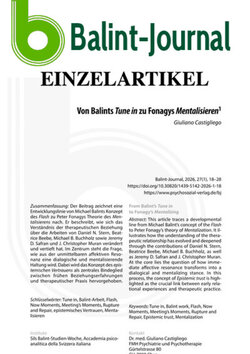
Der Beitrag zeichnet eine Entwicklungslinie von Michael Balints Konzept des Flash zu Peter Fonagys Theorie des Mentalisierens nach. Er beschreibt, wie sich das Verständnis der therapeutischen Beziehung über die Arbeiten von Daniel N. Stern, Beatrice Beebe, Michael B. Buchholz sowie Jeremy D. Safran und J. Christopher Muran verändert und vertieft hat. Im Zentrum steht die Frage, wie aus der unmittelbaren affektiven Resonanz eine dialogische und mentalisierende Haltung wird. Dabei wird das Konzept des epistemischen Vertrauens als zentrales Bindeglied zwischen frühen Beziehungserfahrungen und therapeutischer Praxis hervorgehoben.
Abstract:
This article traces a developmental line from Michael Balint’s concept of the Flash to Peter Fonagy’s theory of Mentalization. It illustrates how the understanding of the therapeutic relationship has evolved and deepened through the contributions of Daniel N. Stern, Beatrice Beebe, Michael B. Buchholz, as well as Jeremy D. Safran and J. Christopher Muran. At the core lies the question of how immediate affective resonance transforms into a dialogical and mentalizing stance. In this process, the concept of Epistemic trust is highlighted as the crucial link between early relational experiences and therapeutic practice.
Abstract:
This article traces a developmental line from Michael Balint’s concept of the Flash to Peter Fonagy’s theory of Mentalization. It illustrates how the understanding of the therapeutic relationship has evolved and deepened through the contributions of Daniel N. Stern, Beatrice Beebe, Michael B. Buchholz, as well as Jeremy D. Safran and J. Christopher Muran. At the core lies the question of how immediate affective resonance transforms into a dialogical and mentalizing stance. In this process, the concept of Epistemic trust is highlighted as the crucial link between early relational experiences and therapeutic practice.
Guido FlattenS. 2–3Editorial (PDF)
Giovanni MaioS. 7–17Zur Bedeutung des Vertrauens in der Medizin (PDF)
Giuliano CastigliegoS. 18–28Von Balints Tune in zu Fonagys Mentalisieren (PDF)
Vanessa Viktoria EylersS. 29–39Mut zur Polyphonie (PDF)
Ein musikalischer Zugangsweg zur Leitung von BalintgruppenGuido Flatten, Philipp Herzog & Günther Bergmann S. 40–53Von der Fähigkeit zur Kompetenz (PDF)
Die Ausbildung zum Balint-GruppenleiterAndré HoppmannS. 54–56»Ich wünsche Dir Leben ohne Leiden« (PDF)
Darstellung einer besonderen IFA-Gruppe mit erfolgtem Perspektivwechsel und Entlastung bei der FallvorstellungGünther BergmannS. 57–61Rezension von: Rexroth, C., Lienert, S. & Endres, M. (Hg.). (2025). Kursbuch Psychosomatische Grundversorgung in der Kinderund Jugendmedizin (PDF)
Giovanni MaioS. 7–17Zur Bedeutung des Vertrauens in der Medizin (PDF)
Giuliano CastigliegoS. 18–28Von Balints Tune in zu Fonagys Mentalisieren (PDF)
Vanessa Viktoria EylersS. 29–39Mut zur Polyphonie (PDF)
Ein musikalischer Zugangsweg zur Leitung von BalintgruppenGuido Flatten, Philipp Herzog & Günther Bergmann S. 40–53Von der Fähigkeit zur Kompetenz (PDF)
Die Ausbildung zum Balint-GruppenleiterAndré HoppmannS. 54–56»Ich wünsche Dir Leben ohne Leiden« (PDF)
Darstellung einer besonderen IFA-Gruppe mit erfolgtem Perspektivwechsel und Entlastung bei der FallvorstellungGünther BergmannS. 57–61Rezension von: Rexroth, C., Lienert, S. & Endres, M. (Hg.). (2025). Kursbuch Psychosomatische Grundversorgung in der Kinderund Jugendmedizin (PDF)