
 36214.jpg
20 Seiten, PDF-E-Book
Erschienen: März 2026
Bestell-Nr.: 36214
https://doi.org/10.30820/0743-4804-2026-36-67
John Conger
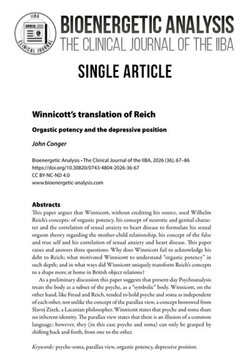
Winnicott’s translation of Reich (PDF)
Orgastic potency and the depressive position
Sofortdownload
Dies ist ein E-Book. Unsere E-Books sind mit einem personalisierten Wasserzeichen versehen,
jedoch frei von weiteren technischen Schutzmaßnahmen (»DRM«).
Erfahren Sie hier mehr zu den Datei-Formaten.
Diese Arbeit argumentiert, dass Winnicott, ohne seine Quelle anzugeben, Wilhelm Reichs Konzepte der Orgasmuspotenz, des neurotischen und genitalen Charakters sowie des Zusammenhangs zwischen sexueller Angst und Herzerkrankungen nutzte, um seine Theorie des sexuellen Orgasmus in Bezug auf die Mutter-Kind-Beziehung, sein Konzept des falschen und wahren Selbst und seinen Zusammenhang zwischen sexueller Angst und Herzerkrankungen zu formulieren. Die Arbeit wirft drei Fragen auf und beantwortet sie: Warum verschweigt Winnicott seine Verbindung zu Reich? Was motivierte Winnicott, die «Orgasmuspotenz” so tiefgründig zu verstehen? Und inwiefern transformierte Winnicott Reichs Konzepte auf einzigartige Weise, um sie an die britische Objektbeziehungstheorie anzupassen? Vorab wird diskutiert, dass die heutige Psychoanalyse den Körper als Teil der Psyche, als «symbolischen” Körper, betrachtet. Winnicott hingegen, ähnlich wie Freud und Reich, betrachtete Psyche und Soma als voneinander unabhängig, nicht unähnlich dem Parallaxenmodell, einem Konzept des Lacan’schen Philosophen Slavoj Žižek. Winnicott argumentiert, dass Psyche und Soma keine inhärente Identität besitzen. Das Parallaxenmodell besagt, dass eine Illusion einer gemeinsamen Sprache existiert; Psyche und Soma lassen sich jedoch nur erfassen, indem man zwischen ihnen hinund herwechselt.
Abstract:
This paper argues that Winnicott, without crediting his source, used Wilhelm Reich’s concepts: of orgastic potency, his concept of neurotic and genital character and the correlation of sexual anxiety to heart disease to formulate his sexual orgasm theory regarding the mother-child relationship, his concept of the false and true self and his correlation of sexual anxiety and heart disease. This paper raises and answers three questions: Why does Winnicott fail to acknowledge his debt to Reich; what motivated Winnicott to understand «orgastic potency” in such depth; and in what ways did Winnicott uniquely transform Reich’s concepts to a shape more at home in British object relations? As a preliminary discussion this paper suggests that present-day Psychoanalysis treats the body as a subset of the psyche, as a «symbolic” body. Winnicott, on the other hand, like Freud and Reich, tended to hold psyche and soma as independent of each other, not unlike the concept of the parallax view, a concept borrowed from Slavoj Zizek, a Lacanian philosopher. Winnicott states that psyche and soma share no inherent identity. The parallax view states that there is an illusion of a common language; however, they (in this case psyche and soma) can only be grasped by shifting back and forth, from one to the other.
Abstract:
Cet article soutient que Winnicott, sans citer ses sources, a utilisé les concepts de Wilhelm Reich: la puissance orgastique, son concept de caractère névrotique et génital, et la corrélation entre l’anxiété sexuelle et les maladies cardiaques, pour formuler sa théorie de l’orgasme sexuel dans le contexte de la relation mère-enfant, son concept du faux et du vrai soi, et sa corrélation entre l’anxiété sexuelle et les maladies cardiaques. Cet article soulève et répond à trois questions: pourquoi Winnicott omet-il de reconnaître sa dette envers Reich? Qu’est-ce qu’a motivé Winnicott à approfondir sa compréhension de la «puissance orgastique”? Et de quelle manière Winnicott a-t-il transformé de façon singulière les concepts de Reich pour les adapter au contexte britannique des relations d’objet? En guise de réflexion préliminaire, cet article suggère que la psychanalyse contemporaine considère le corps comme un sous-ensemble de la psyché, comme un corps «symbolique”. Winnicott, à l’instar de Freud et Reich, tendait à considérer le psychisme et le soma comme indépendants l’un de l’autre, une conception proche de celle de la théorie de la parallaxe, empruntée à Slavoj Žižek, philosophe lacanien. Winnicott affirme que le psychisme et le soma ne partagent aucune identité intrinsèque. La théorie de la parallaxe postule l’illusion d’un langage commun; or, le psychisme et le soma ne peuvent être appréhendés qu‘en passant de l’un à l’autre.
Abstract:
Questo articolo sostiene che Winnicott, senza citare la fonte, abbia utilizzato il concetto di Wilhelm Reich di potenza orgasmica, il suo concetto di carattere nevrotico e genitale e la correlazione tra ansia sessuale e cardiopatia per formulare la sua teoria dell’orgasmo sessuale riguardante la relazione madre-bambino, il suo concetto di falso e vero sé e la sua correlazione tra ansia sessuale e cardiopatia. Questo articolo solleva e risponde a tre domande: perché Winnicott non riconosce il suo debito nei confronti di Reich; cosa lo ha spinto a comprendere la «potenza orgasmica” in modo così approfondito; e in che modo Winnicott ha trasformato in modo unico i concetti di Reich in una forma più congeniale alle relazioni oggettuali britanniche? Come discussione preliminare, questo articolo suggerisce che la psicoanalisi odierna tratta il corpo come un sottoinsieme della psiche, come un corpo «simbolico”. Winnicott, d’altra parte, come Freud e Reich, tendeva a considerare psiche e soma indipendenti l’uno dall’altro, non diversamente dal concetto di parallasse, un concetto preso in prestito da Slavoj Žižek, un filosofo lacaniano. Winnicott afferma che psiche e soma non condividono alcuna identità intrinseca. La parallasse afferma che esiste l’illusione di un linguaggio comune; tuttavia, essi (in questo caso psiche e soma) possono essere compresi solo passando avanti e indietro, dall‘uno all‘altro.
Abstract:
This paper argues that Winnicott, without crediting his source, used Wilhelm Reich’s concepts: of orgastic potency, his concept of neurotic and genital character and the correlation of sexual anxiety to heart disease to formulate his sexual orgasm theory regarding the mother-child relationship, his concept of the false and true self and his correlation of sexual anxiety and heart disease. This paper raises and answers three questions: Why does Winnicott fail to acknowledge his debt to Reich; what motivated Winnicott to understand «orgastic potency” in such depth; and in what ways did Winnicott uniquely transform Reich’s concepts to a shape more at home in British object relations? As a preliminary discussion this paper suggests that present-day Psychoanalysis treats the body as a subset of the psyche, as a «symbolic” body. Winnicott, on the other hand, like Freud and Reich, tended to hold psyche and soma as independent of each other, not unlike the concept of the parallax view, a concept borrowed from Slavoj Zizek, a Lacanian philosopher. Winnicott states that psyche and soma share no inherent identity. The parallax view states that there is an illusion of a common language; however, they (in this case psyche and soma) can only be grasped by shifting back and forth, from one to the other.
Abstract:
Cet article soutient que Winnicott, sans citer ses sources, a utilisé les concepts de Wilhelm Reich: la puissance orgastique, son concept de caractère névrotique et génital, et la corrélation entre l’anxiété sexuelle et les maladies cardiaques, pour formuler sa théorie de l’orgasme sexuel dans le contexte de la relation mère-enfant, son concept du faux et du vrai soi, et sa corrélation entre l’anxiété sexuelle et les maladies cardiaques. Cet article soulève et répond à trois questions: pourquoi Winnicott omet-il de reconnaître sa dette envers Reich? Qu’est-ce qu’a motivé Winnicott à approfondir sa compréhension de la «puissance orgastique”? Et de quelle manière Winnicott a-t-il transformé de façon singulière les concepts de Reich pour les adapter au contexte britannique des relations d’objet? En guise de réflexion préliminaire, cet article suggère que la psychanalyse contemporaine considère le corps comme un sous-ensemble de la psyché, comme un corps «symbolique”. Winnicott, à l’instar de Freud et Reich, tendait à considérer le psychisme et le soma comme indépendants l’un de l’autre, une conception proche de celle de la théorie de la parallaxe, empruntée à Slavoj Žižek, philosophe lacanien. Winnicott affirme que le psychisme et le soma ne partagent aucune identité intrinsèque. La théorie de la parallaxe postule l’illusion d’un langage commun; or, le psychisme et le soma ne peuvent être appréhendés qu‘en passant de l’un à l’autre.
Abstract:
Questo articolo sostiene che Winnicott, senza citare la fonte, abbia utilizzato il concetto di Wilhelm Reich di potenza orgasmica, il suo concetto di carattere nevrotico e genitale e la correlazione tra ansia sessuale e cardiopatia per formulare la sua teoria dell’orgasmo sessuale riguardante la relazione madre-bambino, il suo concetto di falso e vero sé e la sua correlazione tra ansia sessuale e cardiopatia. Questo articolo solleva e risponde a tre domande: perché Winnicott non riconosce il suo debito nei confronti di Reich; cosa lo ha spinto a comprendere la «potenza orgasmica” in modo così approfondito; e in che modo Winnicott ha trasformato in modo unico i concetti di Reich in una forma più congeniale alle relazioni oggettuali britanniche? Come discussione preliminare, questo articolo suggerisce che la psicoanalisi odierna tratta il corpo come un sottoinsieme della psiche, come un corpo «simbolico”. Winnicott, d’altra parte, come Freud e Reich, tendeva a considerare psiche e soma indipendenti l’uno dall’altro, non diversamente dal concetto di parallasse, un concetto preso in prestito da Slavoj Žižek, un filosofo lacaniano. Winnicott afferma che psiche e soma non condividono alcuna identità intrinseca. La parallasse afferma che esiste l’illusione di un linguaggio comune; tuttavia, essi (in questo caso psiche e soma) possono essere compresi solo passando avanti e indietro, dall‘uno all‘altro.
Maria Rosaria FiloniS. 7–9Editorial Note (PDF)
Maria Rosaria Filoni, Garry Cockburn, Scott Baum & Yael Harel S. 11–65The Uniqueness of Bioenergetic Analysis (PDF)
Atlanta, USA, October 8-12, 2025John CongerS. 67–86Winnicott’s translation of Reich (PDF)
Orgastic potency and the depressive positionSergey KamratovS. 87–107The Structure of Structure (PDF)
A Functional-Structural Analysis of Character PatternsCamila MacedoS. 109–126Adolescence and the clinical work of bioenergetics today (PDF)
Léia M. CardenutoS. 127–150Impulsive/Compulsive Personalities (PDF)
How We Hear and Understand Them in Our Narcissistic SocietyMaria Rosaria FiloniS. 151–152Book review of: Vincentia Schroeter (2025). Babymaking (PDF)
Maria Rosaria FiloniS. 152–153Book review of: Leslie Ann Costello (2025). Helping Mothers, Helping Babies (PDF)
Maria Rosaria Filoni, Garry Cockburn, Scott Baum & Yael Harel S. 11–65The Uniqueness of Bioenergetic Analysis (PDF)
Atlanta, USA, October 8-12, 2025John CongerS. 67–86Winnicott’s translation of Reich (PDF)
Orgastic potency and the depressive positionSergey KamratovS. 87–107The Structure of Structure (PDF)
A Functional-Structural Analysis of Character PatternsCamila MacedoS. 109–126Adolescence and the clinical work of bioenergetics today (PDF)
Léia M. CardenutoS. 127–150Impulsive/Compulsive Personalities (PDF)
How We Hear and Understand Them in Our Narcissistic SocietyMaria Rosaria FiloniS. 151–152Book review of: Vincentia Schroeter (2025). Babymaking (PDF)
Maria Rosaria FiloniS. 152–153Book review of: Leslie Ann Costello (2025). Helping Mothers, Helping Babies (PDF)