
 29292.jpg
23 Seiten, PDF-E-Book
Erschienen: Juni 2025
Bestell-Nr.: 29292
https://doi.org/10.30820/1616-8836-2025-1-55
abonnieren
Eckhard Sperling & Ursula Sperling
Die Einbeziehung der Großeltern in die Familientherapie (1976) (PDF)
Sofortdownload
Dies ist ein E-Book. Unsere E-Books sind mit einem personalisierten Wasserzeichen versehen,
jedoch frei von weiteren technischen Schutzmaßnahmen (»DRM«).
Erfahren Sie hier mehr zu den Datei-Formaten.
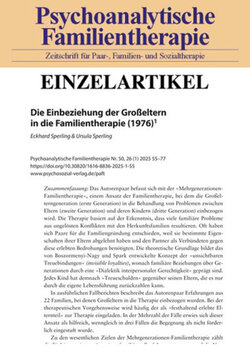
In ausführlichen Fallberichten beschreibt das Autorenpaar Erfahrungen aus 22 Familien, bei denen Großeltern in die Therapie einbezogen wurden. Bei der therapeutischen Vorgehensweise wird häufig der als »festhaltend erlebte Elternteil« zur Therapie eingeladen. In der Mehrzahl der Fälle erwies sich dieser Ansatz als hilfreich, wenngleich in drei Fällen die Begegnung als nicht förderlich eingestuft wurde. Zu den wesentlichen Zielen der Mehrgenerationen-Familientherapie zählt die Einleitung eines präventiven familiären Entfaltungsprozesses und die Vermeidung von Vereinsamung und Isolierung älterer Menschen. Sie hilft, Abhängigkeiten zu überwinden, indem sie die Beteiligten dazu zwingt, andere Wege als die soziale Ausklammerung zu suchen.
Abstract:
The authors examine »multigenerational family therapy«, an approach to family therapy that involves the grandparents (first generation) in the treatment of problems between parents (second generation) and their children (third generation). The therapy is based on the insight that many family problems result from unresolved conflicts with the families of origin. Couples often decide to start a family because they reject certain characteristics of their parents and need their partner as an ally against these perceived threats. The theoretical basis is the concept of »invisible loyalties« developed by Boszormenyi-Nagy and Spark, according to which family relationships across generations are shaped by a »dialectic of interpersonal justice«. According to this concept, every child has an »obligation of loyalty« to their parents, which they can only repay through their own way of life. In detailed case reports, the authors describe experiences from 22 families in which grandparents were involved in therapy. In the therapeutic approach, the parent who is perceived as »holding on« is often invited to therapy. In the majority of cases, this approach proved helpful, although in three cases the encounter was not considered beneficial. The main goals of multigenerational family therapy include initiating a preventive family development process and preventing loneliness and isolation among older people. It helps overcome dependencies by forcing those involved to seek alternatives to social exclusion.
Abstract:
The authors examine »multigenerational family therapy«, an approach to family therapy that involves the grandparents (first generation) in the treatment of problems between parents (second generation) and their children (third generation). The therapy is based on the insight that many family problems result from unresolved conflicts with the families of origin. Couples often decide to start a family because they reject certain characteristics of their parents and need their partner as an ally against these perceived threats. The theoretical basis is the concept of »invisible loyalties« developed by Boszormenyi-Nagy and Spark, according to which family relationships across generations are shaped by a »dialectic of interpersonal justice«. According to this concept, every child has an »obligation of loyalty« to their parents, which they can only repay through their own way of life. In detailed case reports, the authors describe experiences from 22 families in which grandparents were involved in therapy. In the therapeutic approach, the parent who is perceived as »holding on« is often invited to therapy. In the majority of cases, this approach proved helpful, although in three cases the encounter was not considered beneficial. The main goals of multigenerational family therapy include initiating a preventive family development process and preventing loneliness and isolation among older people. It helps overcome dependencies by forcing those involved to seek alternatives to social exclusion.
Trin Haland-Wirth, Joseph Kleinschnittger, Astrid Kunze, Inken Seifert-Karb & Hans-Jürgen Wirth S. 5–9Editorial (PDF)
Horst-Eberhard RichterS. 12–36Zur Theorie und Therapie familiärer Beziehungsstörungen aus psychoanalytischer Sicht (1970) (PDF)
Helm StierlinS. 37–53Familientherapeutische Aspekte der Übertragung und Gegenübertragung (1977) (PDF)
Eckhard Sperling & Ursula Sperling S. 55–77Die Einbeziehung der Großeltern in die Familientherapie (1976) (PDF)
Jürg WilliS. 79–95Der Kampf der Geschlechter als Kollusion (1978) (PDF)
Thea BauriedlS. 97–121Das Konzept der Beziehungsanalyse in der psychoanalytischen Paar- und Familientherapie (2001) (PDF)
Michael StaschS. 123Nachrichten aus dem Bundesverband (PDF)
Horst-Eberhard RichterS. 12–36Zur Theorie und Therapie familiärer Beziehungsstörungen aus psychoanalytischer Sicht (1970) (PDF)
Helm StierlinS. 37–53Familientherapeutische Aspekte der Übertragung und Gegenübertragung (1977) (PDF)
Eckhard Sperling & Ursula Sperling S. 55–77Die Einbeziehung der Großeltern in die Familientherapie (1976) (PDF)
Jürg WilliS. 79–95Der Kampf der Geschlechter als Kollusion (1978) (PDF)
Thea BauriedlS. 97–121Das Konzept der Beziehungsanalyse in der psychoanalytischen Paar- und Familientherapie (2001) (PDF)
Michael StaschS. 123Nachrichten aus dem Bundesverband (PDF)