
 23645.jpg
24 Seiten, PDF-E-Book
Erschienen: November 2025
Bestell-Nr.: 23645
https://doi.org/10.30820/0341-7301-2025-4-305
abonnieren
Georg Feuser
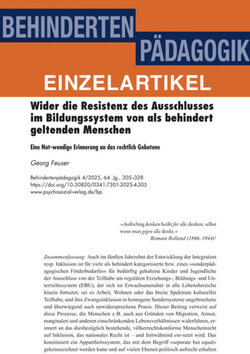
Wider die Resistenz des Ausschlusses im Bildungssystem von als behindert geltenden Menschen (PDF)
Eine Not-wendige Erinnerung an das rechtlich Gebotene
Sofortdownload
Dies ist ein E-Book. Unsere E-Books sind mit einem personalisierten Wasserzeichen versehen,
jedoch frei von weiteren technischen Schutzmaßnahmen (»DRM«).
Erfahren Sie hier mehr zu den Datei-Formaten.
Auch im fünften Jahrzehnt der Entwicklung der Integration resp. Inklusion ist für viele als behindert kategorisierte bzw. eines »sonderpädagogischen Förderbedarfes« für bedürftig gehaltene Kinder und Jugendliche der Ausschluss von der Teilhabe am regulären Erziehungs-, Bildungsund Unterrichtssystem (EBU), der sich im Erwachsenenalter in alle Lebensbereiche hinein fortsetzt, sei es Arbeit, Wohnen oder das breite Spektrum kultureller Teilhabe, und ihre Zwangsinklusion in homogene Sondersysteme ungebrochene und überwiegend auch unwidersprochene Praxis. Dieser Beitrag verweist auf diese Prozesse, die Menschen z.B. auch aus Gründen von Migration, Armut, marginalen und anderen einschränkenden Lebensverhältnissen widerfahren, erinnert an das diesbezüglich bestehende, völkerrechtskonforme Menschenrecht auf Inklusion, das nationales Recht ist – und fortwährend ent-setzt wird. Das konstituiert ein Appartheitssystem, das mit dem Begriff »separate but equal« gekennzeichnet werden kann und auf vielen Ebenen politisch aufrecht erhalten bleibt, was exemplarisch aufgezeigt wird – bis in die Kreise der vom Verfassungsschutz als »gesichert rechtsextrem« beurteilten AfD, aber: historisch gesehen, dieser nicht originär entstammt. In sieben Punkten werden die bedingenden historischen Prozesse skizziert und auf den von Bourdieu aufgezeigten »Staatsgeist«, verwiesen, der uns denken lässt, wie wir denken. Es ist immer die Zustimmung zu etwas Gesagtem, das das Gesagte Realität werden lassen kann.
Abstract:
Even in the fifth decade of the development of integration and inclusion, for many children and young people categorized as having disabilities or deemed to have »special educational needs«, exclusion from participation in the regular education, training, and instruction system (EBU) which continues into adulthood in all areas of life, e.g. professional work, housing, or the broad spectrum of cultural participation, and their forced inclusion in homogenous special systems remains an unbroken and largely unchallenged practice. This article points to these processes, which people experience, for example, due to migration, poverty, marginal, and other restrictive living conditions, and reminds us of the existing human right to inclusion, which is national law – and is continually being violated. This constitutes an apartheid system that can be characterized with the term »separate but equal« and is politically maintained on many levels, as is demonstrated by examples – even in the circles of the AfD, which the Federal Office for the Protection of the Constitution considers »certainly right-wing extremist«, but historically speaking, does not originate from this party. In seven points, the determining historical processes are outlined and reference is made to the »state spirit« identified by Bourdieu, which makes us think the way we think. It is always the consent to something said that can make it become reality.
Abstract:
Even in the fifth decade of the development of integration and inclusion, for many children and young people categorized as having disabilities or deemed to have »special educational needs«, exclusion from participation in the regular education, training, and instruction system (EBU) which continues into adulthood in all areas of life, e.g. professional work, housing, or the broad spectrum of cultural participation, and their forced inclusion in homogenous special systems remains an unbroken and largely unchallenged practice. This article points to these processes, which people experience, for example, due to migration, poverty, marginal, and other restrictive living conditions, and reminds us of the existing human right to inclusion, which is national law – and is continually being violated. This constitutes an apartheid system that can be characterized with the term »separate but equal« and is politically maintained on many levels, as is demonstrated by examples – even in the circles of the AfD, which the Federal Office for the Protection of the Constitution considers »certainly right-wing extremist«, but historically speaking, does not originate from this party. In seven points, the determining historical processes are outlined and reference is made to the »state spirit« identified by Bourdieu, which makes us think the way we think. It is always the consent to something said that can make it become reality.
Erik WeberS. 303–304Editorial (PDF)
Georg FeuserS. 305–328Wider die Resistenz des Ausschlusses im Bildungssystem von als behindert geltenden Menschen (PDF)
Eine Not-wendige Erinnerung an das rechtlich GeboteneErik WeberS. 329–346Geistige (?) Behinderung (?) - intellektuelle (?) Beeinträchtigung (?) - Störungen (?) der Intelligenzentwicklung (?) - Herausforderungen bei der Gestaltung inklusiver Bildungsund
Julia FischerS. 347–364Partizipative Deinstitutionalisierung durch bedarfsorientierte Wohnberatung (PDF)
Florian GramsS. 365–378Die Würde des Menschen beginnt und endet nicht im Ideenhimmel der Philosophen (PDF)
Vom Kampf um die MenschenrechteAlicia Hanf, Susanne Weger-Wiens & Annika Wagner S. 379–380Behindertenpädagogik in Hessen (PDF)
Schwerpunktthema: Inklusionsorientierte Diagnostik von Lernverläufen an Übergängen von Jugendlichen und Erwachsenen mit LernschwierigkeitenSilke Schreiber-Barsch, Wiebke Curdt & Anette Richter-Boisen S. 381–394MEIN.Profil (PDF)
Inklusionsorientierte Diagnostik von Lernverläufen an den Übergängen inklusiver BildungLeo FreundS. 395–398Aus der Verbandarbeit (PDF)
Georg FeuserS. 305–328Wider die Resistenz des Ausschlusses im Bildungssystem von als behindert geltenden Menschen (PDF)
Eine Not-wendige Erinnerung an das rechtlich GeboteneErik WeberS. 329–346Geistige (?) Behinderung (?) - intellektuelle (?) Beeinträchtigung (?) - Störungen (?) der Intelligenzentwicklung (?) - Herausforderungen bei der Gestaltung inklusiver Bildungsund
Julia FischerS. 347–364Partizipative Deinstitutionalisierung durch bedarfsorientierte Wohnberatung (PDF)
Florian GramsS. 365–378Die Würde des Menschen beginnt und endet nicht im Ideenhimmel der Philosophen (PDF)
Vom Kampf um die MenschenrechteAlicia Hanf, Susanne Weger-Wiens & Annika Wagner S. 379–380Behindertenpädagogik in Hessen (PDF)
Schwerpunktthema: Inklusionsorientierte Diagnostik von Lernverläufen an Übergängen von Jugendlichen und Erwachsenen mit LernschwierigkeitenSilke Schreiber-Barsch, Wiebke Curdt & Anette Richter-Boisen S. 381–394MEIN.Profil (PDF)
Inklusionsorientierte Diagnostik von Lernverläufen an den Übergängen inklusiver BildungLeo FreundS. 395–398Aus der Verbandarbeit (PDF)