
 23685.jpg
19 Seiten, PDF-E-Book
Erschienen: November 2026
Bestell-Nr.: 23685
https://doi.org/10.30820/0341-7301-2026-4-355
abonnieren
Annalena Ziemski
Gesellschaftliche Arbeit neu denken (PDF)
Eine von Marx ausgehende Bestimmung gesellschaftlicher Arbeit im Kontext komplexer Behinderung
Sofortdownload
Dies ist ein E-Book. Unsere E-Books sind mit einem personalisierten Wasserzeichen versehen,
jedoch frei von weiteren technischen Schutzmaßnahmen (»DRM«).
Erfahren Sie hier mehr zu den Datei-Formaten.
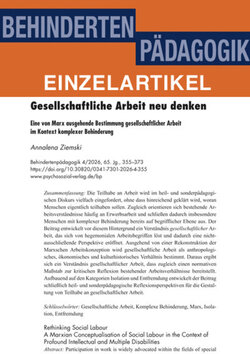
Die Teilhabe an Arbeit wird im heilund sonderpädagogischen Diskurs vielfach eingefordert, ohne dass hinreichend geklärt wird, woran Menschen eigentlich teilhaben sollen. Zugleich orientieren sich bestehende Arbeitsverständnisse häufig an Erwerbsarbeit und schließen dadurch insbesondere Menschen mit komplexer Behinderung bereits auf begrifflicher Ebene aus. Der Beitrag entwickelt vor diesem Hintergrund ein Verständnis gesellschaftlicher Arbeit, das sich von hegemonialen Arbeitsbegriffen löst und dadurch eine nicht-ausschließende Perspektive eröffnet. Ausgehend von einer Rekonstruktion der Marxschen Arbeitskonzeption wird gesellschaftliche Arbeit als anthropologisches, ökonomisches und kulturhistorisches Verhältnis bestimmt. Daraus ergibt sich ein Verständnis gesellschaftlicher Arbeit, dass zugleich einen normativen Maßstab zur kritischen Reflexion bestehender Arbeitsverhältnisse bereitstellt. Aufbauend auf den Kategorien Isolation und Entfremdung entwickelt der Beitrag schließlich heilund sonderpädagogische Reflexionsperspektiven für die Gestaltung von Teilhabe an gesellschaftlicher Arbeit.
Abstract:
Participation in work is widely advocated within the fields of special and inclusive education. However, there has been little discussion of what people are actually expected to participate in. At the same time, prevailing understandings of work are largely centred on paid employment and, as a result, exclude people with profound intellectual and multiple disabilities at the conceptual level. Against this background, the present article develops a concept of social labour that moves beyond hegemonic notions of work and thereby offers a non-exclusionary perspective. Drawing on a reconstruction of Marx’s conception of labour, social labour is conceptualised as an anthropological, economic, and cultural-historical relation. This understanding simultaneously provides a normative framework for the critical reflection of existing labour relations. Building on the concepts of isolation and alienation, the article finally develops perspectives for special and inclusive educational practice aimed at enabling participation in social labour.
Erik WeberS. 303Editorial (PDF)
Rahel SchowalterS. 305–321Zuschreibungen im Kontext komplexer Behinderung (PDF)
Julia TierbachS. 323–342Deutungskämpfe im (Sub-)Feld der Pädagogik bei Autismus und die Rolle symbolischer Gewaltverhältnisse (PDF)
Matthias DalferthS. 343–353Devianz und Kriminalität im Autistischen Spektrum 3 (PDF)
Autistische Menschen als Opfer von StraftatenAnnalena ZiemskiS. 355–373Gesellschaftliche Arbeit neu denken (PDF)
Eine von Marx ausgehende Bestimmung gesellschaftlicher Arbeit im Kontext komplexer BehinderungCarolin MarschallS. 375–378Rezension von: Helmwart Hierdeis & Achim Würker (2026). Schule und Individualisierung (PDF)
Alicia Hanf, Susanne Weger-Wiens & Annika Wagner S. 379Behindertenpädagogik in Hessen (PDF)
Schwerpunktthema: Umgang mit belastendem Verhalten und Konflikten in der SchuleLucia B. Amrhein, Benjamin Badstieber & Malte Thiede S. 381–395Vom BMBF-Forschungsprojekt zum Transfer in die Fläche (PDF)
Die Entwicklung von Umbraise für den multiprofessionellen Umgang mit belastendem Verhalten und KonfliktenLeo FreundS. 397–399Aus der Verbandsarbeit (PDF)