
 26825.jpg
9 Seiten, PDF-E-Book
Erschienen: August 2026
Bestell-Nr.: 26825
https://doi.org/10.30820/0171-3434-2026-3-19
abonnieren
Timo Storck
Verlust und Verbleib (PDF)
Für eine psychoanalytisch begründete Verlustfähigkeit
Sofortdownload
Dies ist ein E-Book. Unsere E-Books sind mit einem personalisierten Wasserzeichen versehen,
jedoch frei von weiteren technischen Schutzmaßnahmen (»DRM«).
Erfahren Sie hier mehr zu den Datei-Formaten.
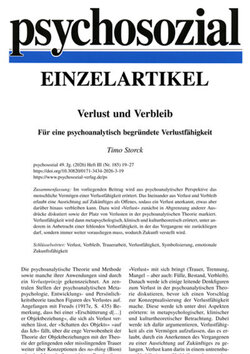
Im vorliegenden Beitrag wird aus psychoanalytischer Perspektive das menschliche Vermögen einer Verlustfähigkeit erörtert. Das Ineinander aus Verlust und Verbleib erlaubt eine Ausrichtung auf Zukünftiges als Offenes, sodass ein Verlust anerkannt, etwas aber darüber hinaus verbleiben kann. Dazu wird »Verlust« zunächst in Abgrenzung anderer Ausdrücke diskutiert sowie der Platz von Verlusten in der psychoanalytischen Theorie markiert. Verlustfähigkeit wird dann metapsychologisch, klinisch und kulturtheoretisch erörtert, unter anderem in Anbetracht einer fehlenden Verlustfähigkeit, in der das Vergangene nie zurückliegen darf, sondern immer weiter vorausliegen muss, wodurch Zukunft verstellt wird.
Abstract:
This paper discusses, from a psychoanalytic perspective, the human capacity for loss (»lossability«). The interweaving of loss and remaining allows for an orientation toward the future as something open, such that a loss may be acknowledged while something nevertheless remains beyond it. To this end, »loss« is first discussed in distinction from other terms, and the place of losses within psychoanalytic theory is delineated. The capacity for loss is then examined from metapsychological, clinical, and cultural-theoretical perspectives, including consideration of a lacking capacity for loss, in which the past must never be allowed to recede, but instead must always continue to lie ahead, blocking off actual futures.
Abstract:
This paper discusses, from a psychoanalytic perspective, the human capacity for loss (»lossability«). The interweaving of loss and remaining allows for an orientation toward the future as something open, such that a loss may be acknowledged while something nevertheless remains beyond it. To this end, »loss« is first discussed in distinction from other terms, and the place of losses within psychoanalytic theory is delineated. The capacity for loss is then examined from metapsychological, clinical, and cultural-theoretical perspectives, including consideration of a lacking capacity for loss, in which the past must never be allowed to recede, but instead must always continue to lie ahead, blocking off actual futures.
Benigna Gerisch & Jürgen Straub S. 5–9Editorial (PDF)
Verluste und ihre VerarbeitungThomas MachoS. 11–18Das Zeitliche segnen (PDF)
Abschied von der UnsterblichkeitTimo StorckS. 19–27Verlust und Verbleib (PDF)
Für eine psychoanalytisch begründete VerlustfähigkeitBenigna GerischS. 29–43Suizidalität als Folge von Objekt-, Selbst- und Weltverlust (PDF)
Hannah WunderlichS. 44–58Verarbeitung von Anerkennungs- und Zugehörigkeitsverlust im Tagebuch (PDF)
Eine exemplarische Interpretation eines ›jüdischen‹ Tagebuchs aus der NS-ZeitKlaus SchmidtS. 59–75(Ver-)Lust und (Ver-)Bindung in spätmodernen Paarbeziehungen (PDF)
Burkhard LiebschS. 76–87Verlust vor Verlust bewahren? (PDF)
Warum sollte das und wie könnte es möglich sein?Lorenz BöllingerS. 91–104Soziopsychoanalyse der Konstruktion von »Macht« (PDF)
Andrea TippeS. 105–107Rezension von: Der Enthusiasmus des Nützlichseinwollens: Eine Forschungscollage (PDF)
Oliver KönigS. 107–110Rezension von: Die nie endende Arbeit an sich selbst: Der zweite Weltkrieg als Laboratorium der neuen Sozialtechnologien (PDF)
Roland KaufholdS. 110–113Rezension von: Die Folgen der NS-Zeit »bedeutete[n] für die psychoanalytische Arbeit eine neuartige Aufgabe« (PDF)
Helmwart HierdeisS. 114–117Rezension von: Analyse des Zeitgeists via Gegenübertragungsanalyse (PDF)
Verluste und ihre VerarbeitungThomas MachoS. 11–18Das Zeitliche segnen (PDF)
Abschied von der UnsterblichkeitTimo StorckS. 19–27Verlust und Verbleib (PDF)
Für eine psychoanalytisch begründete VerlustfähigkeitBenigna GerischS. 29–43Suizidalität als Folge von Objekt-, Selbst- und Weltverlust (PDF)
Hannah WunderlichS. 44–58Verarbeitung von Anerkennungs- und Zugehörigkeitsverlust im Tagebuch (PDF)
Eine exemplarische Interpretation eines ›jüdischen‹ Tagebuchs aus der NS-ZeitKlaus SchmidtS. 59–75(Ver-)Lust und (Ver-)Bindung in spätmodernen Paarbeziehungen (PDF)
Burkhard LiebschS. 76–87Verlust vor Verlust bewahren? (PDF)
Warum sollte das und wie könnte es möglich sein?Lorenz BöllingerS. 91–104Soziopsychoanalyse der Konstruktion von »Macht« (PDF)
Andrea TippeS. 105–107Rezension von: Der Enthusiasmus des Nützlichseinwollens: Eine Forschungscollage (PDF)
Oliver KönigS. 107–110Rezension von: Die nie endende Arbeit an sich selbst: Der zweite Weltkrieg als Laboratorium der neuen Sozialtechnologien (PDF)
Roland KaufholdS. 110–113Rezension von: Die Folgen der NS-Zeit »bedeutete[n] für die psychoanalytische Arbeit eine neuartige Aufgabe« (PDF)
Helmwart HierdeisS. 114–117Rezension von: Analyse des Zeitgeists via Gegenübertragungsanalyse (PDF)